
Stop Blaming Your Marketing:
Why Most Businesses Actually Have a Customer Acquisition System Problem
“Our marketing isn’t working.”
It’s one of the most common frustrations we hear from business owners.
“We’ve tried Google Ads; We’ve hired a social media agency; We’ve redesigned our website; We’ve invested in SEO.”
“But we’re still not getting the growth we expected.”
The natural conclusion is that the marketing isn’t working. But in many established businesses, that’s not actually the problem.
The real issue is that marketing has become disconnected from the rest of the customer journey.
Marketing creates opportunities. A customer acquisition system turns those opportunities into revenue. Unfortunately, many businesses have one without the other.
The myth of “more leads”
When sales slow down, the default response is usually to generate more leads.
- Increase the advertising budget.
- Launch another campaign.
- Try a new platform.
- Hire another agency.
This approach assumes that the problem is a lack of enquiries. But what if your business is already generating enough opportunities?
What if those opportunities are simply not being managed effectively?
A business that converts 10% of 100 enquiries gains 10 customers. Improve the system and convert 20% instead, and the same marketing effort produces 20 customers.
The biggest opportunity isn’t always finding more leads. Sometimes it’s making better use of the ones you already have.
What is a customer acquisition system?
A customer acquisition system is the connected process that takes someone from their first interaction with your business to becoming a paying customer.
- It isn’t a single piece of software.
- It isn’t your CRM.
- It isn’t your website.
- It isn’t your advertising.
It’s how all of those elements work together.
An effective acquisition system includes five essential stages:
1. Attract
Generate enquiries from the right audience using targeted marketing. The goal isn’t maximum traffic. It’s attracting people who are likely to become customers.
2. Capture
Every enquiry should be recorded immediately. No missed emails. No forgotten contact forms. No sticky notes on someone’s desk. Every opportunity should enter a structured process.
3. Qualify
Not every lead deserves the same attention. Some are ready to buy. Some need nurturing. Some are not the right fit. Qualification helps your team focus time where it creates the greatest return.
4. Follow up
This is where many businesses lose momentum. An enquiry sits unanswered. A proposal isn’t chased. A customer chooses a competitor simply because they responded faster. Consistent follow-up is often the difference between average and exceptional growth.
5. Convert and measure
Every acquisition system should provide visibility into performance. Which marketing channels generate customers? How much does each customer cost to acquire? What percentage of enquiries convert? Where are prospects dropping out? Without measurement, improvement becomes guesswork.
Why marketing alone rarely fixes growth
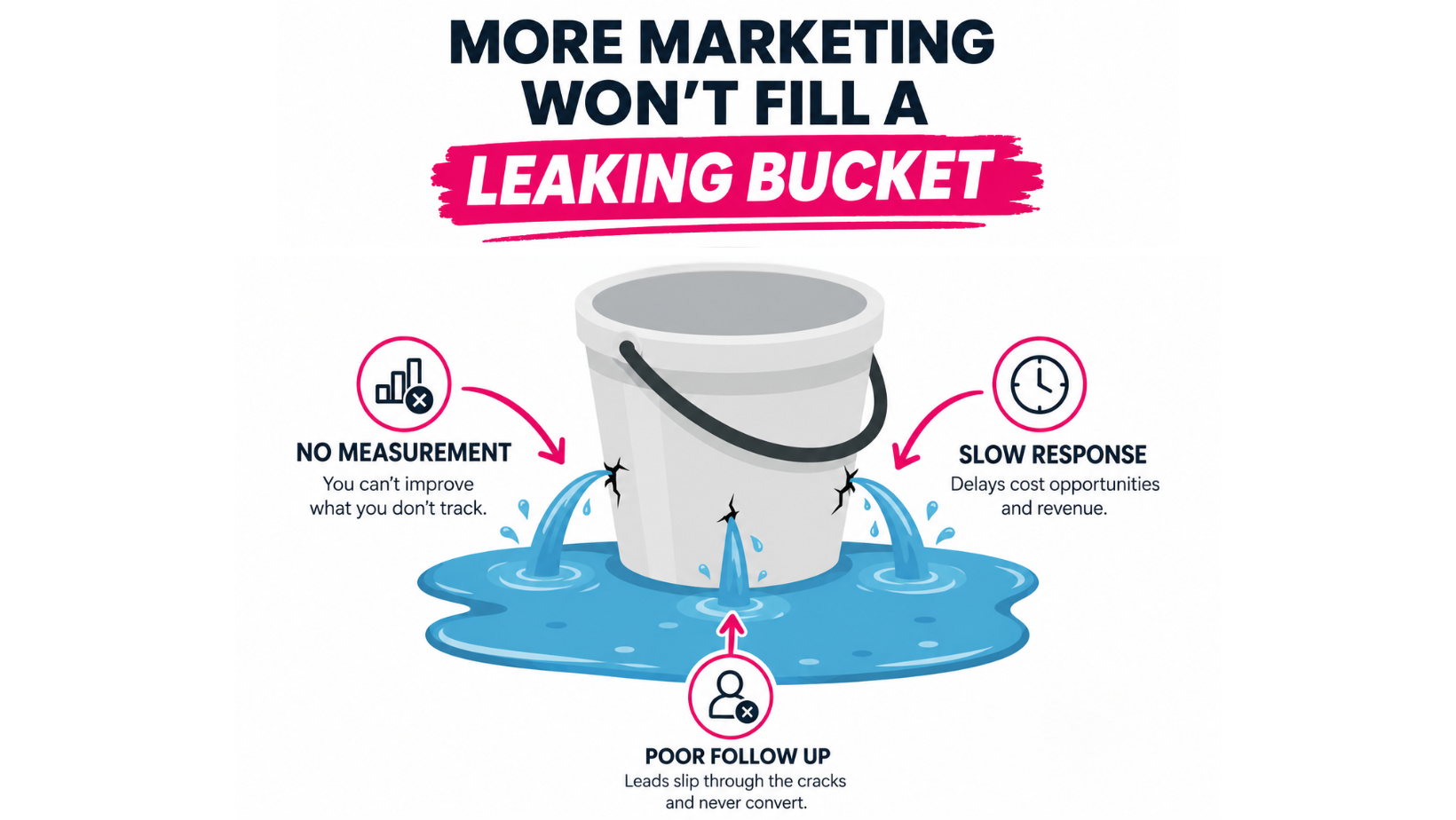
Marketing can increase awareness. It can generate enquiries. It can create demand. But marketing cannot compensate for poor internal processes.
- If enquiries disappear into inboxes, advertising won’t solve that.
- If nobody follows up consistently, SEO won’t solve that.
- If leadership has no visibility into conversion rates, social media won’t solve that.
More marketing poured into a weak process simply amplifies the weaknesses already present. Growth becomes expensive instead of sustainable.
The hidden signs your acquisition system needs attention
Many businesses don’t realise they have a systems problem because revenue is still coming in.
- Referrals keep the pipeline moving.
- Existing customers continue to buy.
- The business appears healthy.
Yet beneath the surface, growth is constrained by operational friction.
- Some common warning signs include:
- Leads arrive but nobody knows who owns them.
- Response times vary depending on who is available.
- Different departments use different systems.
- Sales reporting is inconsistent or incomplete.
- Leadership cannot confidently explain which marketing activities generate revenue.
- Follow-up depends on individual effort instead of a defined process.
- Marketing agencies report clicks and impressions, but management cannot connect them to sales.
These issues rarely create a crisis overnight. Instead, they quietly reduce profitability month after month.
Building a business that scales
Businesses don’t become scalable because they spend more on advertising. They become scalable because they build repeatable systems.
The strongest organisations know exactly how customers move through their acquisition journey.
- They understand where prospects are lost.
- They measure conversion at every stage.
- They continually improve the process rather than simply increasing activity.
Marketing then becomes significantly more effective because every enquiry enters a system designed to produce measurable outcomes.
The question every business owner should ask
Before increasing your marketing budget, ask yourself:
- Do we know exactly how many enquiries we receive each month?
- Do we know how many become paying customers?
- Can we identify where prospects are dropping out?
- Is follow-up consistent across the business?
- Do we understand our cost per customer acquisition?
- Can leadership clearly measure return on marketing investment?
If the answer to several of these questions is no, the greatest opportunity may not be more marketing.
It may be building a better acquisition system.
Sustainable growth starts with connected systems
The businesses that achieve predictable growth are rarely the ones making the most noise.
- They are the ones with the clearest processes.
- Every enquiry is captured.
- Every opportunity is qualified.
- Every prospect is followed up.
- Every result is measured.
Marketing becomes more profitable because it operates within a system designed to convert attention into revenue. If your business is investing in marketing but the results don’t reflect the investment, it may be time to stop asking, “How do we get more leads?”
Instead, ask a more valuable question:“How well does our business turn opportunities into customers?”
The answer to that question often reveals the biggest opportunity for sustainable growth.