The Five Places Your Business Is Probably Losing Customers
(Without Realising It)

Most businesses don’t lose customers because their competitors are better. They lose them because their own process breaks down.
- Sometimes the enquiry sits in an inbox.
- Sometimes nobody follows up.
- Sometimes the quote arrives too late.
- Sometimes the lead was never qualified properly.
These aren’t marketing failures. They’re systems failures.
The difficult part is that these problems are often invisible. Sales feel unpredictable, marketing seems inconsistent, and revenue plateaus—even though enquiries are still coming in.
Let’s look at the five most common places businesses unknowingly lose customers.
Leak #1: Poor Quality Lead Generation
Not every lead is worth pursuing.
Many businesses focus on generating as many enquiries as possible rather than attracting the right enquiries. The result is a sales team spending valuable time speaking to people who were never likely to become customers.
Good lead generation isn’t about volume. It’s about relevance.
When your marketing clearly communicates who you help, what problems you solve, and who your service is designed for, you naturally attract prospects who are a better fit.
Fewer qualified leads often produce better results than hundreds of poor-quality enquiries.
Leak #2: Leads Aren’t Captured Properly
A surprising number of opportunities disappear before anyone even knows they existed.
- A contact form fails.
- An email lands in spam.
- A WhatsApp message is missed.
- A receptionist forgets to record an enquiry.
Without a reliable system for capturing every lead, businesses create silent revenue leaks that are almost impossible to measure.
Every enquiry should immediately enter a central system where it can be tracked, assigned, and followed through to completion.
If a customer has already shown interest, they shouldn’t have to chase you.
Leak #3: Slow Response Times
Speed matters more than most businesses realise.
When someone makes an enquiry, they’re usually researching several providers at the same time. The business that responds first often earns the opportunity to build trust first.
Even a delay of a few hours can significantly reduce the likelihood of converting a lead—especially in competitive industries. Quick responses don’t always require someone sitting behind a computer all day.
Simple automations can acknowledge enquiries immediately, notify the right team members, and ensure no lead waits unnecessarily.
Being responsive tells customers that you’ll probably be reliable throughout the rest of the relationship too.
Leak #4: Inconsistent Follow-Up
Most sales aren’t lost after the first conversation.
They’re lost because the second conversation never happens.
People get busy. Priorities change. Decision-makers need time to compare options. That doesn’t mean they’re no longer interested.
Businesses that rely on memory or sticky notes to remember follow-ups inevitably let opportunities slip away. A structured follow-up process keeps conversations moving without feeling pushy.
Sometimes one additional email, one reminder, or one phone call is the difference between a lost opportunity and a new client.
Consistency beats intensity every time.
Leak #5: No Visibility Into Conversion
Many business owners know how many enquiries they receive.
Far fewer know exactly where those enquiries are being lost.
- How many become qualified opportunities?
- How many receive quotes?
- How many convert into paying customers?
- How long does each stage take?
Without this visibility, improving performance becomes guesswork.
When every stage of your customer journey is measured, patterns quickly emerge. You can identify bottlenecks, improve weak points, and make informed decisions instead of relying on assumptions.
What gets measured gets improved.
Small Improvements Create Big Results
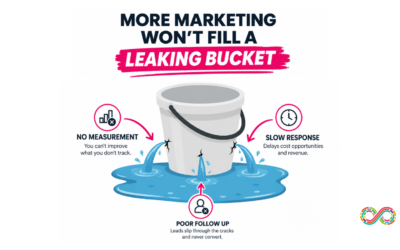
Many businesses believe they need more marketing. Often, they simply need fewer leaks.
Improving each stage of your customer acquisition process—even by a small amount—creates a compounding effect.
- A few more qualified leads.
- A few more enquiries captured.
- A few faster responses.
- A few more follow-ups completed.
- A little more visibility into what’s working.
Each improvement builds on the previous one.
If your business improved each stage by just 10%, the combined impact could transform revenue without increasing marketing spend.
At If Infinite, we call this Digital Acquisition—building systems that don’t just generate leads, but reliably turn opportunities into customers. Because sustainable growth isn’t about doing more marketing; it’s about making every opportunity count.
Let’s have an honest conversation about where your marketing is and where the gaps might be. Click here to talk to us about your business.